



A Short Guide to Chisels
Click here for the entire chisel department
We get a lot of
questions about chisels. Some of the questions are about different brands,
but many are about how different styles of chisels are used for different
applications. A century ago, tool catalogs carried pages and pages of
chisels - different sizes, different shapes, different styles, an amazing
array. A good many of the styles and shapes popular then have disappeared.
However,
the basic criteria for selecting a set of chisels have stayed the same.
The descriptions below are not exhaustive. They'll to help explain the
basic styles and use of each type of chisel. Click on any of the photographs
to get to the department where we stock those type of chisels and for
more information on specific models of chisel. (For the moment we have
left out unusual styles and special purpose chisels to concentrate on
the styles that are most popular.) For a detailed definition of the
entire family of chisels and in fact all and woodworking tools we highly
recommend the classic (but sadly now out of print) Dictionary of Woodworking Tools by R. A. Salaman.
Beveled Edged Bench Chisels
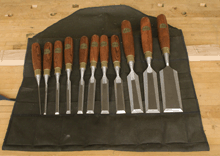 Not too short and not too long these chisels are the most common and most useful chisel found in a cabinet shop. The most important criteria are that they should be comfortable in the hand, hold a good edge, and be easy to sharpen. The backs of the chisel should be flat or very slightly hollow for ease of sharpening. They are beveled on the sides for allowing maximum access to dovetails. They are the most important first set of chisels for any shop with the widest array of sizes available. Some versions are hooped to strengthen the handle for malleting but this isn't really necessary, and plenty of styles have no extra hooping for a lower balance point.
Heavy Duty Beveled Edged Chisels
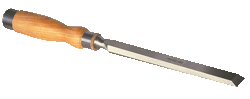 Not really used much in furniture making. This is a fine choice for boat building and to a lesser
extent timberframing, or any application where the joinery is big and complicated. However because demand is so low we do not stock this style of chisel.
Not really used much in furniture making. This is a fine choice for boat building and to a lesser
extent timberframing, or any application where the joinery is big and complicated. However because demand is so low we do not stock this style of chisel.Registered Chisels
Any chisel except a mortise chisel with square, rather than beveled sizes. Usually hooped. Used in timberframing and of limited use for general woodworking. Due to low demand we currently do not stock any of these type chisels.Japanese Bench Chisels
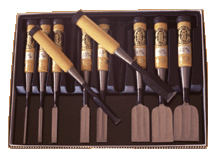 Similar in size to Western bench chisels, of laminated steel construction and in general
thicker than their Western counterparts. The major difference is that Japanese
bench chisels come from a framing tradition and usually have less of a beveling
on the sides (especially in the narrower sizes). Other then that they usually
are a very high quality chisel, hooped and with hollow ground backs. The
edges are harder than Western chisels, which is why they do so well on lab
tests. Japanese chisels are designed to take a very keen edge for cutting
softwoods without crumbling, and to resist the natural abrasion of topical
exotic woods. A special type of dovetail chisel was introduced for western
woodworker which is triagular in section and has narrower edges then any
Western chisel.
Similar in size to Western bench chisels, of laminated steel construction and in general
thicker than their Western counterparts. The major difference is that Japanese
bench chisels come from a framing tradition and usually have less of a beveling
on the sides (especially in the narrower sizes). Other then that they usually
are a very high quality chisel, hooped and with hollow ground backs. The
edges are harder than Western chisels, which is why they do so well on lab
tests. Japanese chisels are designed to take a very keen edge for cutting
softwoods without crumbling, and to resist the natural abrasion of topical
exotic woods. A special type of dovetail chisel was introduced for western
woodworker which is triagular in section and has narrower edges then any
Western chisel.Mortise Chisels
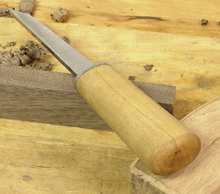 In the classic tradition of mortising, a chisel is malleted into the wood and then
levered out to remove waste. Bench chisels don't have the thickness to withstand
the levering out, nor the stout blade angle to resist abuse, nor the length
to put leverage behind the levering out. In addition, the abuse would quickly
chip the blades and mushroom the handles of a nice set of bench chisels
used for fine joinery. A special class of mortising chisel was developed.
True English mortise chisels had not been manufactured for over 50 years.
We take great pleasure in bringing them back to the market. These are heavy
chisels, thicker than they are wide, with giant forged bolsters and oval
beech or oak handles to take pounding. However, you will find them very
easy to handle and a joy to use. Now available in sizes 1/8" - 1/2"
by 1/16". It is perfectly acceptable to just have one mortise chisel
( 1/4" or 3/8" being the most common) and size all your mortises
accordingly. With rare exception, mortise strength is determined by total
glue surface, not width of the tenon.
In the classic tradition of mortising, a chisel is malleted into the wood and then
levered out to remove waste. Bench chisels don't have the thickness to withstand
the levering out, nor the stout blade angle to resist abuse, nor the length
to put leverage behind the levering out. In addition, the abuse would quickly
chip the blades and mushroom the handles of a nice set of bench chisels
used for fine joinery. A special class of mortising chisel was developed.
True English mortise chisels had not been manufactured for over 50 years.
We take great pleasure in bringing them back to the market. These are heavy
chisels, thicker than they are wide, with giant forged bolsters and oval
beech or oak handles to take pounding. However, you will find them very
easy to handle and a joy to use. Now available in sizes 1/8" - 1/2"
by 1/16". It is perfectly acceptable to just have one mortise chisel
( 1/4" or 3/8" being the most common) and size all your mortises
accordingly. With rare exception, mortise strength is determined by total
glue surface, not width of the tenon. Sash Mortise Chisels
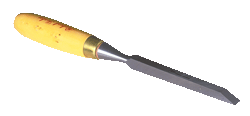 Sash mortise chisels are light mortising chisels that are easy to handle
and were originally used for chopping the relatively shallow mortises found
in the mullions and muntins of a wooden window. If you consistently drill
out the waste when mortising, these chisels will work well even for deep
mortises. However, they are of thinner section than regular mortising
chisels (see comment about heavy duty mortise sash mortise chisels below).
Traditionally, mortise chisels were sold in a wide range of sizes, but were
bought in a much more limited range. Demand has been very low since we started selling regular mortise chisels and we no longer stock this style.
Sash mortise chisels are light mortising chisels that are easy to handle
and were originally used for chopping the relatively shallow mortises found
in the mullions and muntins of a wooden window. If you consistently drill
out the waste when mortising, these chisels will work well even for deep
mortises. However, they are of thinner section than regular mortising
chisels (see comment about heavy duty mortise sash mortise chisels below).
Traditionally, mortise chisels were sold in a wide range of sizes, but were
bought in a much more limited range. Demand has been very low since we started selling regular mortise chisels and we no longer stock this style. Heavy Duty Sash Mortise Chisels
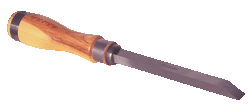 Originally developed in Continental Europe, these chisels are a heavier version of the sash mortise chisel. They are more general purpose and will get the job done. The round handles and square chisel section make them less
comfortable to use than true English mortise chisels, but these features
also make them less expensive to manufacture, and they certainly work. Prior
to the re-introduction of true English mortise chisels, we were pretty happy
with this style. Now we recommend them only for the occasional mortise. Due to low demand we no longer stock this style of chisel.
Originally developed in Continental Europe, these chisels are a heavier version of the sash mortise chisel. They are more general purpose and will get the job done. The round handles and square chisel section make them less
comfortable to use than true English mortise chisels, but these features
also make them less expensive to manufacture, and they certainly work. Prior
to the re-introduction of true English mortise chisels, we were pretty happy
with this style. Now we recommend them only for the occasional mortise. Due to low demand we no longer stock this style of chisel.
Paring Chisels
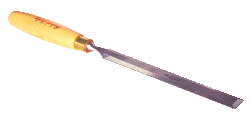 Paring chisels are
light, long, thin, almost flexible chisels which are never malleted. They
are used primarily for carefully shaving off thin amounts of wood when fitting
joints. The long length gives maximum control. One hand on the handle pushes
the chisel forward while the other hand, up front on the blade, guides the
cutting action. A classic use is to dress the sides of a mortise after roughly
chopping it square with a mortise chisel. A secondary investment, very handy
to have if you do a lot of joinery.
Paring chisels are
light, long, thin, almost flexible chisels which are never malleted. They
are used primarily for carefully shaving off thin amounts of wood when fitting
joints. The long length gives maximum control. One hand on the handle pushes
the chisel forward while the other hand, up front on the blade, guides the
cutting action. A classic use is to dress the sides of a mortise after roughly
chopping it square with a mortise chisel. A secondary investment, very handy
to have if you do a lot of joinery. |
Hours: M-F 9:00-5:00, closed Sat,Sun Our Guarantee & Return Policy Shipping and Sales Tax Info Privacy Policy Holiday Calendar |

|
Contact Us:
Email: support@toolsforworkingwood.com Phone: 800-426-4613 or 718-499-5877 Visit Us in Brooklyn: Directions to Our Showroom © 1999-2019 toolsforworkingwood.com Powered by 01 Inc. Coded entirely in NYC |