



Information on Using Hand Cut Rasps.
Click here for more information on the history and design of rasps.
Click here to see our entire range of Auriou rasps
For Gramercy rasps click here, here, and here
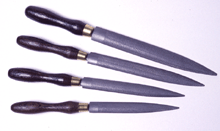
We use the word "rasp" to denote the entire family of the tool when we're talking generally about the use of the tool. When the particular details matter, we say "rasps" to mean a rasp with a handle at one end. We use the term "riffler rasp" or "riffler" to describe a type of rasp with teeth cut in both ends, with an area to hold onto in the middle. Rifflers can be either "file cut," with long lines of teeth, or "rasp cut," with pointy teeth. "Riffler rasp" might be the better term to use. Chances are if you were to go into a general tool store and ask for a "riffler," they would sell you a riffler file.
Most rasps made these days are machine made. Consequently the teeth are in regular rows, one behind the other. What this means is that the rasp will cut little troughs and not leave a smooth surface. The solution to this problem is to slightly vary the tooth position so each row of teeth cuts a slightly different path. This leaves a smooth surface. When you make a rasp by hand, even the most experienced raspmaker will have just enough variation in their work so that the rasp teeth will each cut a slightly separate path and the rasp will cut very fast and smoothly. For more information on the manufacturing process click here.
The Auriou rasps have a much more complete grading system. The process of cutting the teeth on the rasp is known as "stitching" and the finess of the rasp - the size of its teeth - is known as the "grain." Auriou rasps range from #1 to #15 grain. A #1 grain rasp is very, very coarse, and the #15 grain is the very finest. In general, the very coarse rasps aren't used in woodworking, and are mostly in demand by stone carvers. Woodworkers are mostly interested in grains #9 to #15. That being said as you are using hand cut rasps you will find that even the coarse grades cut reasonably fine, and the fine grades reasonably fast.
The cost of a rasp is related to the number of teeth it has. See the photograph on the left (actual size) to see what all the grains look like. What is important to note is that the finer rasps have a greater density of smaller teeth, not fewer larger teeth. Lower quality hand-made rasps will have uneven teeth, which will cut slower and leave scratches.
The teeth on the Auriou rasps are handed so that you can work more comfortably. See below for more information.
Auriou rasps come in many different shapes: flat, round, curved, straight, etc. The most popular rasps are the cabinetmaker's rasps. Some important features are shared by all the styles of rasp. The flat side of a machine-made rasp is always flat, but the flat side of a hand-made rasp is always slightly convex, which makes it far easier to rasp a flat surface. Rat tail rasps are slightly bellied for the same reason. French Cabinetmaker's rasps come to a point. All our hand cut rasps are toothed to the edge. This feature allows you to cut into a sharp corner. With machine made rasps the teeth are a little inset from the edge, which means you cannot work a clean inside corner.
Riffler Rasps
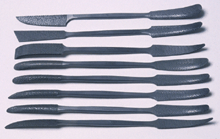
Auriou riffler rasps have a smooth octagonal center section that is easy to hold in position and more comfortable than a square. The shapes are also extremely graceful and visually appealing. The rifflers have gentle curves; they're not just bent in the middle. The oval shapes are true ovals, not just flats that have been rounded off. All of this adds to a rasp that performs solidly and cuts predictably throughout the entire stroke.
Rasps are a shaping tool and are designed to quickly remove wood, leaving a smooth surface ready for final scraping and finish.
All rasps must be handled for use. There are two important reasons for this: first, if the rasp does not have a handle, you will tend to grasp it on the lower part of the teeth. This is not only a great way to cut yourself, it wastes half the stroke of the file and makes every cut take twice as long. The second reason is safety. If the rasp were to catch while you were filing, the tang could punch its way though your hand. So please use a handle. All of our rasps come with handles already installed.
The teeth on Auriou rasps are slightly angled to favor right-handed users. If you are left-handed, please contact us as we can order you left-handed rasp (although we do keep some in stock). The reason has to do with the proper use of a rasp.
A rasp should be grasped by the handle in one hand. This is where the power behind the rasp comes from. The other hand should grasp the tip of the rasp in thumb and forefinger, to balance the pressure on the stroke and to give control. The teeth should be perpendicular to the direction of the stoke. Auriou rasps are handed, so you hold them at an angle to the work but push them perpendicularly to the work. See the diagram below for clarification. The reason for this is that it is more natural and easier to hold the rasp at an angle to your body, which lets you stand closer to the work, giving you more leverage. The exact angle varies but you will find your own sweet spot fairly quickly.
Use the rasp in a long and smooth forward stroke. It will cut very fast. At the end of the stroke, lift the rasp off the work and retract it for the next stroke. The rasp only cuts on the forward stroke. Do not pull back with the rasp against the work, as you will in time dull the rasp prematurely.
Storage and Cleaning
|
Hours: M-F 9:00-5:00, closed Sat,Sun Our Guarantee & Return Policy Shipping and Sales Tax Info Privacy Policy Holiday Calendar |

|
Contact Us:
Email: support@toolsforworkingwood.com Phone: 800-426-4613 or 718-499-5877 Visit Us in Brooklyn: Directions to Our Showroom © 1999-2019 toolsforworkingwood.com Powered by 01 Inc. Coded entirely in NYC |