


|
|
|
On
The History and Manufacture Of Rasps
For
more information on the history and design of rasps, click
here.
|
To see our entire
range of Auriou rasps click here
To see our entire
range of Gramercy rasps click here and here
For Nicholson rasps click here
|

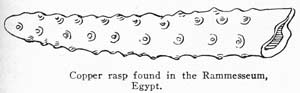
(Image from Henry Disston & Son's publication,
The File in History -1922) |
Abrading
instruments have been used for millennia. Archeologists have found rasps
made out of bronze in Egypt, dating back to the Lisht Dynasty of 1200
- 1000 B.C., and iron rasps used by the ancient Assyrians in the 7th Century
B.C. Rasps and files have a long and illustrious history in just about
every area in the world.
|
 |
Up
until the 1850's, all rasps were hand-made. The process is theoretically
very simple, but requires years of training to do well and consistently.
Steel is forged and then ground to shape. Forging to shape is important
because it gives a better structure to the steel. The grinding only serves
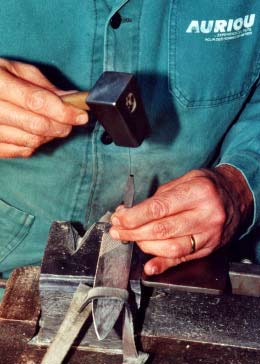
to smooth the rasp blank perfectly so the teeth will be even. A punch
is used to raise a tooth of metal on a piece of steel. Depending on how
coarse or fine a rasp you want to make, the size of the punch and the
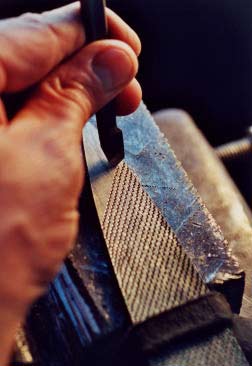
weight of the hammer will vary. The entire surface of the rasp is covered
in teeth. Stitching, as this process is called, is followed by straightening
the rasp with wooden mallets. This is done very carefully so that the
teeth are not damaged. The rasp is then hardened by a case hardening process
that leaves the teeth very hard for years of work but only hardens the
core of the rasp enough so that it won't bend in use. There are obviously
more steps involved; these are the just high points. The key is that the
teeth must be of a uniform size and spread out evenly over the rasp's
surface so that the rasp cuts evenly.
|
 |
Almost
all rasps made today are made by machine. The manufacturing process is
similar to the process described above, with the machine spacing the rasp's
teeth. This can produce a good, but not great rasp, as there are several
problems with this method. First, and more importantly, the machine's
ability to space the teeth precisely results in a rasp that will cut roughly
as each tooth follows in the path of its predecessor. Score marks in the
wood will occur. Human workers, even trying their best to produce a absolutely
regular rasp will end up with minor variations in the placement of the
teeth. Consequently, each tooth will cut a slightly different path than
the tooth before it, giving the rasp an overall much smoother cut.
|
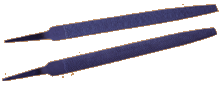
| The
Nickolson #49 and #50 patternmaker's rasps are two exceptions to the machine-made
rule. They are the last gasp of Nicholson's line of top-quality, random-cut
rasps. They are machine-made, but the machine in question is a special gizmo
that, using extensive skilled operator control, allows for minute adjustment
in the position of the teeth so that the resulting spacing is slightly random,
like a hand-cut rasp. These rasps cut very fast and very smoothly. They're
more expensive than rasps that are totally machine made, but they work almost
as well as much more expensive hand-made tools. The one hitch is that these
two styles - the #49 and its finer cut cousin, the #50 - are the only two
styles of Nickolson patternmaker's rasps currently being made. They're are
great tools and we recommend them highly, but sometimes you need other shapes
and these won't suffice. |
|
This brings
up the other advantage of hand made rasps: Hand cut means lots of selection.
When everything is done by hand it is easy to make a huge range of different
types of rasps in a low volume. This is very important now because up
until recently, patternmakers were a big industrial user of rasp because
of the need to precisely shape wooden patterns
for casting. This trade is almost vanished, replaced by CAD and CNC equipment
milling plastic and other more stable materials. Consequently most of
the makers of rasps, and with the two exceptions noted above quality machine
made rasps have vanished. There is not a huge demand for rasps and riffler
rasps these days so volume is low and the only real variety of rasps and
rifflers currently made are all hand made.
There are
a few other makers of hand made riffler rasps in the world. However none
of them are currently producing any tool anywhere near the quality of
the Auriou rasps.
|
Tooth
shape
The tooth of a classically hand-made rasp is pointed and will cut cleanly.
The teeth of a Nicholson #49 or #50 are similar but flatter on top. They
also cut cleanly. On cheaper rasps and rîffler rasps it is easy to see crushed
teeth that were mishandled during the straightening process. Another problem
with poorly made hand made rasps is that the teeth aren't even so you get
scratches. The finess of cut is proportional to the size of the teeth. The
speed of cut is mostly proportional to the density of teeth ion the rasp.
Fine rasps should be covered in perfectly even smaller teeth. Coarse rasps
should also be covered perfectly even larger teeth.
|
Modern
Makers
There have been no makers of hand-made rasps or riffler rasps in the United
States for a long time. The only company producing machine made rasps that
are worth considering is Nicholson and of their current catalog only the
#49 and #50 have any application for woodworkers. Up until recently you
could get hand made riffler rasps from factories in France, Italy, and Austria.
The last batch of rasps we saw from Austria was of appalling quality and
on further investigation it turned out that the company had out-sourced
to China. The teeth were not even, with irregular tips, they did not cut
very smoothly. However if you must have a rasp and cannot justify the expense
of the more professional product the Chinese rasps will serve. However don't
expect the smooth, rapid action of a French rasp. Hand cuts rasps are still
being made in Italy but a cursory investigation hasn't convinced us that
the quality is at it was. Auriou rasps and rifflers, which we do stock are
totally hand made by a factory started in 1856, and are still run by the
family, currently with Michel Auriou at the helm. A huge range is available,
even the coarse grades for stone-work cut very, very quickly and smoothly,
but they are expensive. They are made in the classic French style, with
all the rasps and rifflers coming to a point for maximum versatility and
the teeth are densely space, pointed and not broken off. Fortunately they
will last a long time and are well worth the investment in time saved while
using them and the smoothness of cut will save a lot of finishing time.
|
| We
use the term "French Rasp" and Auriou almost interchangeably.
This is because Auriou is the last full range French rasp company still
making rasps in the old tradition. For more information on using rasps,
click
here. |
|
To see
our entire range of Auriou rasps click
here
For Nicholson rasps click
here
|
Click here: to return
|